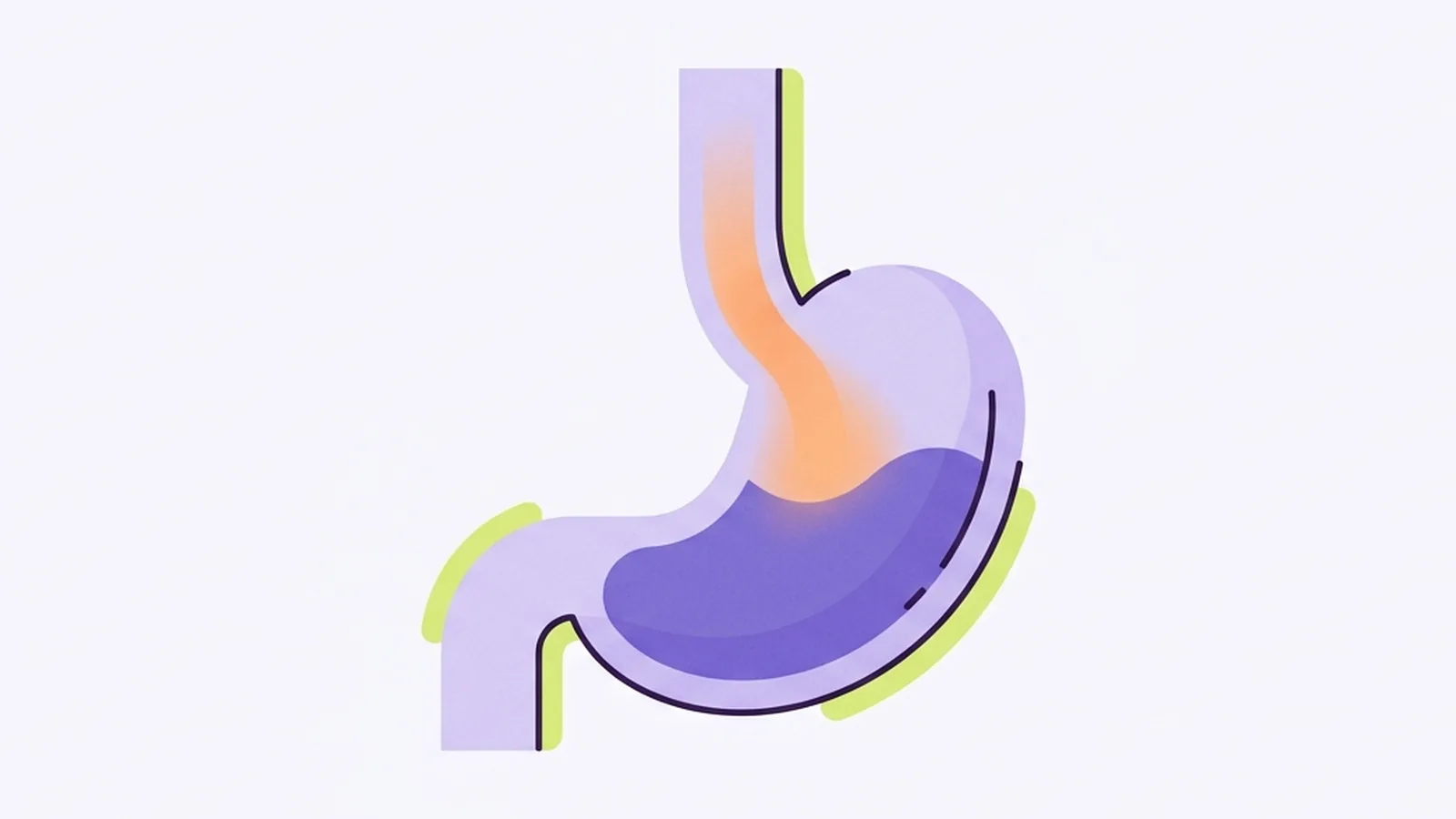
- In the trials behind the US labels, reflux disease (GERD) was reported by 5% of adults on Wegovy 2.4 mg vs 3% on placebo, and by 4–5% on Zepbound vs 2%.1
- Indigestion was more common: 9% on Wegovy vs 3%, and 9–10% on Zepbound vs 4%. Burping was 7% on Wegovy vs under 1%.1
- A 2025 meta-analysis of 55 randomized trials found GLP-1 medicines roughly doubled the risk of a GERD report (risk ratio 2.19), or about 4 extra cases per 1,000 people.2
- A 2025 UK cohort of adults with type 2 diabetes found 27% higher relative risk of a new GERD diagnosis on GLP-1 medicines than on SGLT-2 inhibitors, about 0.7 extra cases per 100 people over 3 years.3
How common is heartburn on Wegovy and Zepbound?
Reflux disease was reported by 5% of adults on semaglutide 2.4 mg (Wegovy) and 3% on placebo in the 68-week STEP 1, 2 and 3 trials, and by 4% to 5% on tirzepatide (Zepbound) vs 2% on placebo in the 72-week SURMOUNT-1 and SURMOUNT-2 trials, according to the 2026 US labels.1 Both pools enrolled adults with obesity or overweight, some with type 2 diabetes.
Three related terms show up in the labels. GERD (gastroesophageal reflux disease) means stomach contents flowing back up into the food pipe, which you feel as heartburn or a sour taste. Dyspepsia is indigestion: discomfort or burning in the upper belly after eating. Eructation is burping.
| Side effect | Wegovy 2.4 mg | Placebo | Zepbound 5 / 10 / 15 mg | Placebo |
|---|---|---|---|---|
| Indigestion (dyspepsia) | 9% | 3% | 9% / 9% / 10% | 4% |
| Burping (eructation) | 7% | <1% | 4% / 5% / 5% | 1% |
| Reflux disease (GERD) | 5% | 3% | 4% / 4% / 5% | 2% |
| Gastritis (irritated stomach lining) | 4% | 1% | not listed |
The placebo rates matter. Some heartburn happens anyway over a year and a half. The extra share linked to the medicine is the gap: about 2 to 3 percentage points for GERD and about 6 points for indigestion. In teenagers aged 12 and older on Wegovy, GERD was 4% vs 2% and burping 4% vs 0%.1
What about Ozempic and Mounjaro?
At the lower doses used for type 2 diabetes, the rates are smaller. The Ozempic label reports, for placebo, 0.5 mg and 1 mg: indigestion 1.9%, 3.5% and 2.7%; burping 0%, 2.7% and 1.1%; and GERD 0%, 1.9% and 1.5%. The Mounjaro label reports, for placebo, 5, 10 and 15 mg: indigestion 3%, 8%, 8% and 5%; burping 0.4%, 3.0%, 2.5% and 3.3%; and GERD 0.4%, 1.7%, 2.5% and 1.7%.1 Both come from two placebo-controlled trials in adults with type 2 diabetes.

Do GLP-1 medicines raise the risk of reflux disease long term?
A 2025 meta-analysis in Gastroenterology pooled 55 placebo-controlled randomized trials with 106,395 participants and found GLP-1 medicines "probably increased" the risk of GERD, with a risk ratio of 2.19, or about 4 more cases per 1,000 people than placebo.2 The trials included people with type 2 diabetes, overweight or obesity, or fatty liver disease. The increase looked larger in people with obesity, with weight-loss doses and with dual-agonist drugs like tirzepatide, though those subgroup differences were not statistically significant.2
Two large observational studies looked at real-world prescriptions in adults with type 2 diabetes:
- UK, 2025. Using UK primary care records, researchers compared 24,708 new users of GLP-1 medicines with 89,096 new users of SGLT-2 inhibitors (another diabetes drug class) over a median of 3.0 years. GLP-1 users had a 27% higher relative risk of a new GERD diagnosis (risk ratio 1.27), an absolute difference of 0.7 cases per 100 people. Complications of GERD had a risk ratio of 1.55, an absolute difference of 0.8 per 1,000.3
- US database, 2024. A study in Gut matched 177,666 people starting a GLP-1 medicine with the same number starting another diabetes drug. Overall, GLP-1 use was linked to a 15% higher risk of erosive reflux (hazard ratio 1.15). That came entirely from short-acting drugs such as liraglutide, lixisenatide and exenatide (hazard ratio 1.215). Long-acting GLP-1 medicines, with a half-life of 5 days or more, showed no increase (hazard ratio 0.994).4
The two cohort studies do not fully agree, and both are observational, so they show links rather than proof. The UK authors note they lacked information on diet and lifestyle.3 Neither studied people without diabetes taking the weight-loss doses of Wegovy or Zepbound.
Why do GLP-1 medicines cause heartburn and burping?
The most likely reason is that semaglutide and tirzepatide slow how fast food leaves the stomach, and delayed gastric emptying is a known risk factor for reflux, as the 2025 UK cohort authors put it.3 Both labels state that the drug delays gastric emptying. The Zepbound label adds that this delay is largest after the first dose and diminishes over time.1 Food that sits longer in the stomach has more time to push back up, especially after a large meal or when lying down.
The labels do not name a single cause for reflux, and the trials were not designed to find one. For how much the stomach slows and why the effect partly fades, see gastric emptying and GLP-1s. The Gut study's authors chose to compare short- and long-acting drugs because short-acting ones slow emptying more, which fits the pattern they found.4
When does reflux on a GLP-1 tend to happen?
The Wegovy label says indigestion, belly pain, bloating, burping, gas, GERD, gastritis and hiccups were "most frequently reported during dosage escalation," the weeks when the dose is being stepped up.1 The Zepbound label says the same for nausea, vomiting and diarrhea, and that most people who stopped Zepbound for side effects did so in the first few months.1
We found no published analysis that tracks how long heartburn itself lasts on these medicines. A 2022 Spanish multidisciplinary expert consensus on GLP-1 stomach side effects describes reflux as common in obesity, says it is "occasionally" made worse by these drugs, likely through the early delay in stomach emptying, and says symptoms improve as weight decreases.5 That is expert opinion, not a measured timeline.
What does guidance suggest for GLP-1 heartburn?
Two sources give non-drug advice. The 2022 American College of Gastroenterology (ACG) GERD guideline is written for reflux in general, not for GLP-1 users. It recommends weight loss for people with overweight or obesity (strong recommendation) and suggests avoiding meals within 2 to 3 hours of bedtime, avoiding tobacco, avoiding personal "trigger foods," and raising the head of the bed for nighttime symptoms (all conditional, low-certainty evidence).6
The 2022 GLP-1 consensus lists general eating habits for people starting these medicines:5
- Eat slowly, eat smaller portions, and stop when you feel full.
- Avoid lying down after a meal and avoid eating too close to bedtime.
- Choose easy-to-digest, lower-fat foods.
In its worked example of heartburn after a dose increase, the panel also suggested more frequent, smaller meals, and cutting back on coffee, tea, spicy food, cola, alcohol, carbonated drinks, fatty or fried food, tomato, mint and chocolate. In that example, the clinician also kept the dose steady before increasing it again and prescribed a short course of acid-reducing medicine.5 Dose changes and medicines are decisions for your prescriber. Both labels note that these drugs can affect how other oral medicines are absorbed.1 For eating ideas that are gentler on the stomach, see what to eat on a GLP-1.
Why does reflux matter before surgery or sedation?
Both the Wegovy and Zepbound labels warn of rare reports of pulmonary aspiration, meaning stomach contents getting into the lungs, in people on GLP-1 medicines who had general anesthesia or deep sedation, even when they had followed fasting instructions.1 The labels say the data are insufficient to know whether changing fasting rules or pausing the drug lowers that risk, and they instruct patients to tell their healthcare providers about the medicine before any planned surgery or procedure.1 If you have reflux symptoms, mention them too. For what current anesthesia guidance says, see GLP-1s before surgery.
When is heartburn on a GLP-1 a reason to see a doctor?
The ACG guideline names trouble swallowing, unintended weight loss, bleeding, vomiting and anemia as "alarm symptoms" that call for an endoscopy, a camera exam of the food pipe and stomach, as soon as feasible.6 On a GLP-1, weight loss is expected, so the other signs are the more useful flags. The labels add:
- Severe or lasting stomach problems. The Wegovy Medication Guide says to tell your provider if stomach problems are severe or will not go away. Both labels say the drugs are not recommended in people with severe gastroparesis (a very slow-emptying stomach).1
- Severe upper belly pain, which can spread to the back, with or without vomiting. The labels list this as a possible sign of pancreatitis. See GLP-1 stomach pain for the full list of red flags.1
- Chest pain. The ACG guideline only recommends testing for reflux in chest pain without heartburn after heart disease has been ruled out.6 Chest pain needs urgent care first, not a guess that it is heartburn.
What this research does not show
- How long reflux lasts. No trial we found measured the duration of heartburn or burping on these drugs.
- Long-term risk at weight-loss doses. Both cohort studies were in adults with type 2 diabetes. Neither studied Wegovy or Zepbound doses in people without diabetes.
- Tirzepatide specifically. The cohort studies were mostly about GLP-1-only drugs. The 2025 meta-analysis grouped tirzepatide with the dual agonists and found no significant difference between subgroups.2
- Whether the advice works on a GLP-1. The ACG lifestyle steps were tested in reflux in general, and the GLP-1 consensus is expert opinion.5,6 For the wider picture of GLP-1 side effects, see our side-effects overview.
Common questions
Is heartburn a common side effect of Wegovy?
It is less common than nausea but more common than on placebo. In the STEP 1 to 3 trials summarized in the Wegovy label, indigestion (dyspepsia) was reported by 9% of adults on semaglutide 2.4 mg vs 3% on placebo, and reflux disease (GERD) by 5% vs 3%. Nausea, for comparison, was 44% vs 16%.
Does Mounjaro cause acid reflux?
At diabetes doses, the Mounjaro label reports reflux disease in 1.7% to 2.5% of adults on tirzepatide 5, 10 or 15 mg vs 0.4% on placebo, and indigestion in 5% to 8% vs 3%. At the weight-loss doses used as Zepbound, reflux was 4% to 5% vs 2%.
Why do I burp so much on Zepbound or Ozempic?
Burping (eructation) is listed in both labels: 4% to 5% on Zepbound vs 1% on placebo, and 7% on Wegovy vs under 1%. Slower stomach emptying is the most likely link, though the labels do not state a cause. For sulfur-smelling burps, see GLP-1 diarrhea and sulfur burps.
Does GLP-1 heartburn go away?
The Wegovy label says indigestion, reflux and burping were reported most often during dose escalation. No trial analysis we found reports how long reflux lasts. A 2022 expert consensus on GLP-1 stomach side effects says reflux symptoms tend to improve as weight comes down.
Can I take an antacid or PPI with semaglutide or tirzepatide?
That is a question for your prescriber or pharmacist, who knows your other medicines. Both labels note that these drugs slow stomach emptying and may affect how other oral medicines are absorbed. In the 2022 consensus, a short course of an acid-reducing medicine was one option clinicians used.
Sources
- US prescribing information and Medication Guides: WEGOVY (revised 06/2026), ZEPBOUND (revised 08/2026), OZEMPIC (revised 01/2025) and MOUNJARO (DailyMed, read November 9, 2026). Sections 5, 6.1, 7, 12.2 and Medication Guide.
- Chiang CH, Jaroenlapnopparat A, Colak SC, et al. Glucagon-Like Peptide-1 Receptor Agonists and Gastrointestinal Adverse Events: A Systematic Review and Meta-Analysis. Gastroenterology. 2025;169(6):1268-1281. PubMed · doi:10.1053/j.gastro.2025.06.003
- Noh Y, Yin H, Yu OHY, et al. Glucagon-Like Peptide-1 Receptor Agonists and Risk for Gastroesophageal Reflux Disease in Patients With Type 2 Diabetes : A Population-Based Cohort Study. Ann Intern Med. 2025;178(9):1268-1278. PubMed · doi:10.7326/ANNALS-24-03420
- Liu BD, Udemba SC, Liang K, et al. Shorter-acting glucagon-like peptide-1 receptor agonists are associated with increased development of gastro-oesophageal reflux disease and its complications in patients with type 2 diabetes mellitus: a population-level retrospective matched cohort study. Gut. 2024;73(2):246-254. PubMed · doi:10.1136/gutjnl-2023-329651
- Gorgojo-Martínez JJ, Mezquita-Raya P, Carretero-Gómez J, et al. Clinical Recommendations to Manage Gastrointestinal Adverse Events in Patients Treated with Glp-1 Receptor Agonists: A Multidisciplinary Expert Consensus. J Clin Med. 2022;12(1):145. doi:10.3390/jcm12010145 · Full text (PMC)
- Katz PO, Dunbar KB, Schnoll-Sussman FH, et al. ACG Clinical Guideline for the Diagnosis and Management of Gastroesophageal Reflux Disease. Am J Gastroenterol. 2022;117(1):27-56. PubMed · doi:10.14309/ajg.0000000000001538 · Full text (PMC)
Cite this article: Minh Truong. Does Ozempic or Zepbound cause heartburn and acid reflux? What the research says. GLP-1.app. Updated November 9, 2026. https://glp-1.app/glp-1-heartburn-acid-reflux/
