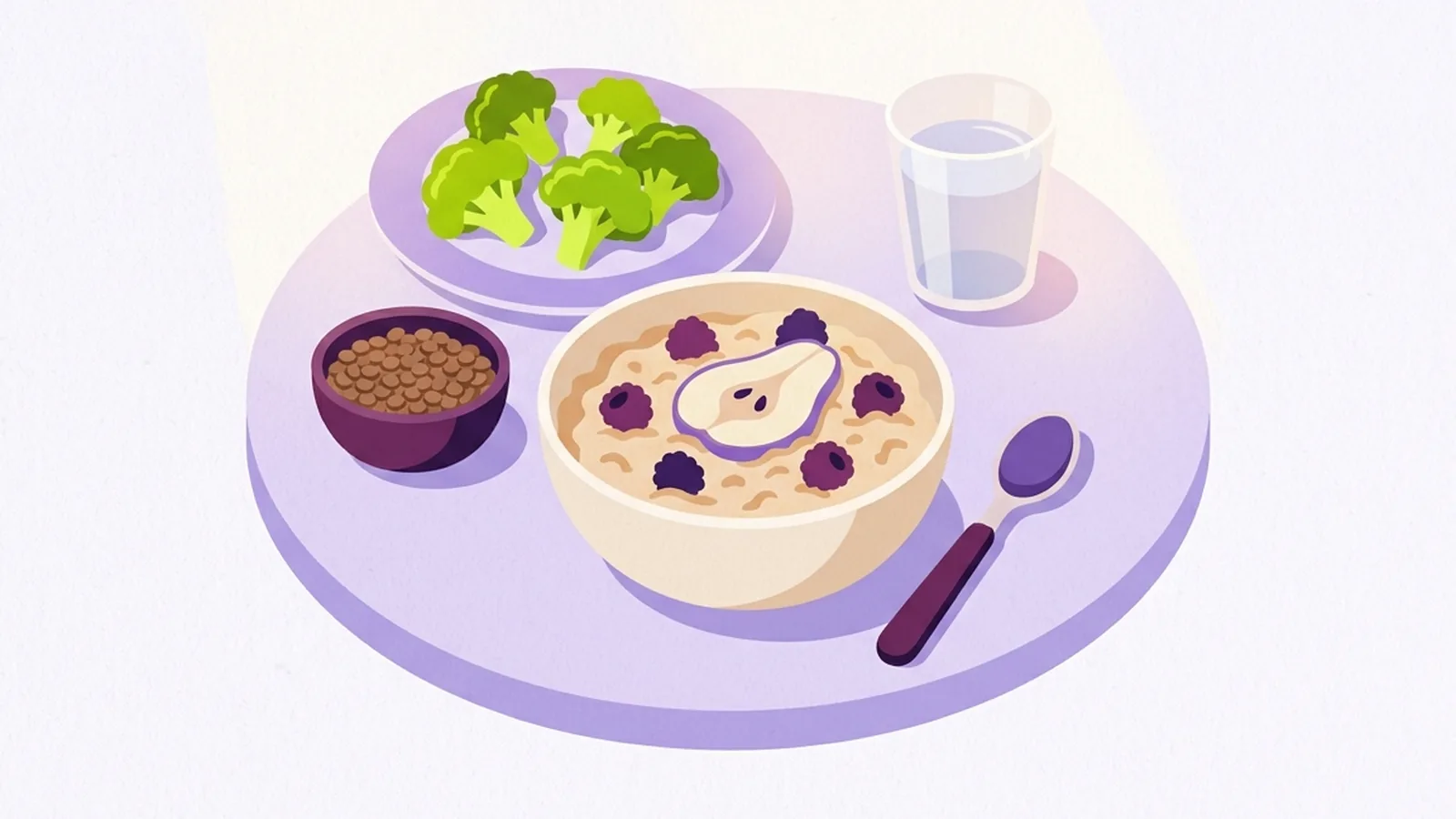
- GLP-1 nutrition guidance encourages fluids and fiber from food, raised gradually, partly because constipation is so common on these medicines.1,2
- The general US target is 14 g of fiber per 1,000 calories, about 22–34 g a day for most adults. More than 90% of US women and 97% of men fall short.4
- On the labels, constipation was reported by 24% of adults on Wegovy 2.4 mg (11% on placebo) and 11–17% on Zepbound (5% on placebo).6
Why fiber gets harder on a GLP-1
GLP-1 medicines such as semaglutide (Ozempic, Wegovy) and tirzepatide (Zepbound, Mounjaro) make people feel full sooner. Meals get smaller. When portions shrink, the foods that carry most fiber, like vegetables, fruit, beans and whole grains, often shrink with them.
That matters because constipation is one of the most common side effects. The 2025 joint advisory from the American College of Lifestyle Medicine, the American Society for Nutrition, the Obesity Medicine Association and The Obesity Society notes that constipation is common with weight loss and "should be managed proactively."1
How common is constipation?
These rates come from the placebo-controlled weight-loss trials summarized in the US labels. All were in adults with obesity or overweight.
| Medicine | Constipation on drug | On placebo |
|---|---|---|
| Wegovy (semaglutide) 2.4 mg | 24% | 11% |
| Wegovy (semaglutide) 7.2 mg, adults with obesity | 20% (19% on 2.4 mg in the same trials) | 8% |
| Zepbound (tirzepatide) 5 / 10 / 15 mg | 17% / 14% / 11% | 5% |
For how long it tends to last and which symptoms need prompt care, see GLP-1 constipation: how common and how long it lasts.
What GLP-1 nutrition guidance says about fiber
None of the guidance sets a special fiber number for people on GLP-1 medicines. What it does say is fairly consistent.
- Fluids and fiber from food first. The 2025 joint advisory says adequate fluids and fiber from foods should be encouraged for constipation, "although additional strategies are often required."1
- Go up slowly. The advisory says a gradual increase in foods with soluble and insoluble fiber, such as prunes or other dried fruits, can be helpful.1
- Timing matters early on. For nausea, the same advisory says smaller, more frequent meals and avoiding fatty or high-fiber foods during the first few days of treatment can help.1
- Diarrhea is different. A 2022 expert consensus on GLP-1 stomach side effects suggests temporarily cutting back on high-fiber foods during diarrhea, then raising fiber gradually once symptoms improve. For constipation, it says to make sure fiber intake is adequate, drink plenty of water and move more.2
- Supplements are a second step. If diet changes are not enough, the advisory lists fiber supplements or capsules among options that may help constipation. It also says fiber capsules or powders can add bulk to stool during diarrhea.1
A 2024 review on nutrition with obesity medicines, written with authors from Eli Lilly, likewise says clinicians can counsel patients on recommended intakes of protein, dietary fiber, micronutrients and fluids before treatment starts.3
How much fiber is the general target?
The 2020-2025 Dietary Guidelines for Americans set fiber goals at 14 g per 1,000 calories, based on the Dietary Reference Intakes. The guidelines say these levels were observed to reduce the risk of coronary heart disease.4
These figures assume a typical calorie intake for each age group, from 1,600 to 2,400 kcal. On a GLP-1, many people eat less than that, which makes a fixed gram target harder to reach. The newer 2025-2030 Dietary Guidelines do not give a gram number. They say to prioritize fiber-rich whole grains and note that high-fiber foods support a diverse gut microbiome.5
Most people are well short even before starting a GLP-1. The 2020-2025 guidelines report that more than 90% of women and 97% of men do not meet recommended fiber intakes.4
How much fiber is in common foods
These values come from USDA FoodData Central. When appetite is low, foods that give a lot of fiber in a small portion help most.
| Food | Portion | Fiber |
|---|---|---|
| Chia seeds, dried | 1 oz (28 g) | 9.8 g |
| Raspberries, raw | 1 cup (123 g) | 8.0 g |
| Lentils, boiled | ½ cup (99 g) | about 7.8 g |
| Blackberries, raw | 1 cup (144 g) | 7.6 g |
| Black beans, boiled | ½ cup (86 g) | about 7.5 g |
| Chickpeas, boiled | ½ cup (82 g) | about 6.2 g |
| Pear, raw | 1 medium (178 g) | 5.5 g |
| Avocado, California | ½ fruit (68 g) | about 4.6 g |
| Oatmeal, cooked with water | 1 cup (234 g) | 4.0 g |
| Green peas, frozen, boiled | ½ cup (80 g) | 3.6 g |
| Almonds | 1 oz, about 23 nuts | 3.5 g |
| Prunes, pitted | 5 prunes (48 g) | about 3.4 g |
| Broccoli, boiled | ½ cup chopped (78 g) | 2.6 g |
| Whole-wheat bread | 1 slice (32 g) | 1.9 g |
| Flaxseed, ground | 1 tbsp (7 g) | 1.9 g |
To show how it adds up: a cup of oatmeal, a cup of raspberries, half a cup of lentils, half a cup of broccoli and a pear come to about 28 g. That is the target for a woman aged 19 to 30 on the guidelines' 2,000-calorie pattern.
Beans, lentils and chickpeas do double duty. The 2025-2030 guidelines list beans, peas, lentils, nuts and seeds among plant protein foods, so they add protein as well as fiber.5 If you are working out a protein range, the free GLP-1 protein calculator can help, and our protein article covers the research.
Practical points from the guidance
- Add fiber in small steps. Both the advisory and the consensus describe a gradual increase, not a sudden jump.1,2
- Drink with it. Fluids come first in every list. Eating less food also means less water from food; see GLP-1 dehydration.
- Watch the first days and dose steps. The advisory links high-fiber and fatty foods to nausea early in treatment.1
- Check with your care team. Ask before adding a fiber supplement, and if constipation lasts or comes with severe belly pain or vomiting.
The advisory also notes that, in the gut, fiber is fermented into short-chain fatty acids that can trigger the body's own GLP-1 release. In animal studies and small human trials, fiber supplements were often linked to higher GLP-1 levels. This is early research, and it does not show that fiber can stand in for the medicine.1
Common questions
How much fiber should I eat on Ozempic or Zepbound?
There is no GLP-1-specific fiber number. The general US target from the 2020-2025 Dietary Guidelines, based on the Dietary Reference Intakes, is 14 g per 1,000 calories, which works out to 22 to 34 g a day for most adults depending on age and sex. GLP-1 nutrition guidance encourages fiber from food and suggests raising it gradually.
Does fiber help constipation on a GLP-1?
A 2025 joint advisory from four US nutrition and obesity societies encourages adequate fluids and fiber from foods for constipation, and says a gradual increase in foods with soluble and insoluble fiber, such as prunes or other dried fruits, can be helpful. It also notes that extra strategies are often needed. Which ones fit you is a question for your clinician.
Should I avoid high-fiber foods when starting a GLP-1?
The 2025 joint advisory says that smaller, more frequent meals and avoiding fatty or high-fiber foods during the first few days of treatment can help ease nausea. A 2022 expert consensus suggests temporarily cutting back on high-fiber foods if you have diarrhea, then increasing fiber gradually once symptoms improve.
Can I take a fiber supplement on Wegovy or Zepbound?
The 2025 joint advisory lists fiber supplements or capsules among options that may help constipation when diet changes are not enough, and says fiber capsules or powders can add bulk to stool if diarrhea occurs. It does not name a product or amount. Ask your clinician or pharmacist before starting one.
Sources
- Mozaffarian D, Agarwal M, Aggarwal M, et al. Nutritional priorities to support GLP-1 therapy for obesity: A joint Advisory from the American College of Lifestyle Medicine, the American Society for Nutrition, the Obesity Medicine Association, and The Obesity Society. Obesity (Silver Spring). 2025;33(8):1475-1503. PubMed · Full text (PMC)
- Gorgojo-Martínez JJ, Mezquita-Raya P, Carretero-Gómez J, et al. Clinical Recommendations to Manage Gastrointestinal Adverse Events in Patients Treated with Glp-1 Receptor Agonists: A Multidisciplinary Expert Consensus. J Clin Med. 2022;12(1):145. PubMed · Full text (PMC)
- Almandoz JP, Wadden TA, Tewksbury C, et al. Nutritional considerations with antiobesity medications. Obesity (Silver Spring). 2024;32(9):1613-1631. PubMed · doi:10.1002/oby.24067
- US Department of Agriculture and US Department of Health and Human Services. Dietary Guidelines for Americans, 2020-2025. 9th Edition. December 2020. Chapter 6 and Appendix 1.
- US Department of Agriculture and US Department of Health and Human Services. Dietary Guidelines for Americans, 2025-2030. January 2026.
- US prescribing information: WEGOVY (semaglutide), DailyMed, revised 06/2026, section 6.1; ZEPBOUND (tirzepatide), DailyMed, revised 08/2026, section 6.1.
- US Department of Agriculture, Agricultural Research Service. FoodData Central, SR Legacy (2018). FDC IDs 170554, 167755, 172421, 173946, 173735, 173757, 169118, 171706, 173905, 170017, 170567, 168162, 169967, 172688, 169414.
Cite this article: Minh Truong. How much fiber do you need on a GLP-1? What the guidance says. GLP-1.app. Updated November 13, 2026. https://glp-1.app/fiber-on-glp-1/
