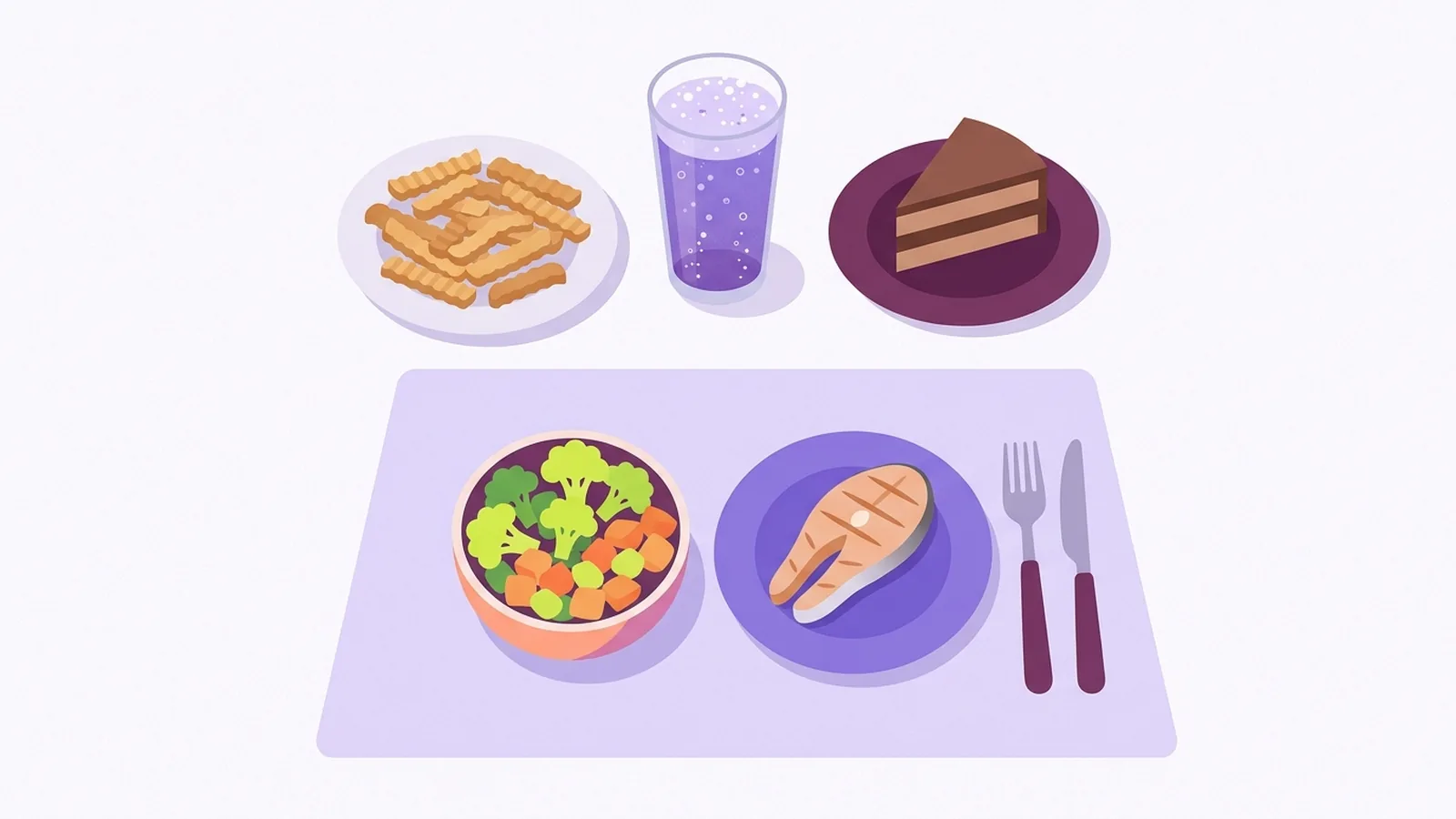
- No food is forbidden: the US labels say Ozempic, Wegovy and Zepbound can be taken with or without meals, but stomach side effects are common, with nausea in 44% of adults on Wegovy vs 16% on placebo.3
- A 2025 joint advisory lists foods to minimize (refined carbs, sugary drinks, red and processed meat, most fast food, sweets and savory snacks) and says large or high-fat meals make vomiting and diarrhea more likely.1
- Coffee has no listed interaction. The FDA cites 400 mg of caffeine a day as generally fine for most adults. Semaglutide tablets need a 30-minute wait before any food or drink.4,5
- Grapefruit is not mentioned in the semaglutide or tirzepatide labels. The orforglipron (Foundayo) pill is different: its label lists CYP3A4 interactions.3,4
Is any food banned on Ozempic, Wegovy or Zepbound?
No. The US labels for semaglutide (Ozempic, Wegovy) and tirzepatide (Zepbound, Mounjaro) says to inject once weekly "with or without meals," and none of the labels lists a food or drink to avoid.3 Wegovy and Zepbound are approved alongside a reduced-calorie diet and more physical activity, but the labels do not spell out that diet.
The "avoid" lists online come from nutrition and gastroenterology guidance on easing stomach side effects, which are common. In the 68-week STEP trials behind the Wegovy label (2,116 adults on 2.4 mg, 1,261 on placebo), nausea was reported by 44% vs 16%, diarrhea by 30% vs 16% and vomiting by 24% vs 6%. In the SURMOUNT trials behind the Zepbound label, nausea was 25% to 29% across doses vs 8% on placebo.3
Foods and drinks to limit on a GLP-1, and why
The 2025 joint advisory from the American College of Lifestyle Medicine, American Society for Nutrition, Obesity Medicine Association and The Obesity Society names five food groups to minimize and says large or high-fat meals worsen side effects.1 A 2022 Spanish multidisciplinary expert consensus on GLP-1 stomach side effects adds items for specific symptoms.2
| Food or drink | Why it is on the list | Source |
|---|---|---|
| Large meals | Vomiting is more likely after large meals | 2025 advisory1 |
| Fatty, fried or fast food | Large or high-fat meals can worsen diarrhea; fat slows the stomach further and can worsen constipation; fried food may worsen reflux | 2025 advisory; 2022 consensus1,2 |
| Sweets, sugary drinks, refined carbs, red and processed meat, savory snacks | Listed to minimize in favor of nutrient-dense foods; the consensus also says to avoid sweet meals when starting | 2025 advisory; 2022 consensus1,2 |
| Alcohol | May worsen nausea and reflux; intake should be minimal | 2025 advisory1 |
| Very high-fiber food in the first days | Avoiding fatty or high-fiber food in the first few days of treatment can ease nausea; fiber is then increased gradually | 2025 advisory1 |
| Spicy food, dressings, store-bought sauces | Listed under general tips to reduce stomach side effects when starting | 2022 consensus2 |
| Carbonated drinks, cola, coffee, tea, tomato, mint, chocolate | Suggested cutbacks for reflux after a dose increase | 2022 consensus2 |
| Sugar alcohols (sorbitol, xylitol), dairy, coffee, soft drinks | Suggested cutbacks during diarrhea | 2022 consensus2 |
The advisory says side effects are most likely when starting or raising the dose, and suggests a small breakfast, then small meals every 3 to 4 hours with enough fluids.1 For what to put on the plate instead, see what to eat on a GLP-1 and our 7-day GLP-1 meal plan.
Why do fatty foods and big meals cause problems on a GLP-1?
The labels state that these drugs delay gastric emptying, and the 2025 advisory notes that foods high in fat or protein slow it further, so a large or greasy meal sits longer in the stomach.1,3 More on the mechanism in gastric emptying and GLP-1s, and on managing symptoms in GLP-1 nausea and stomach side effects.
Can you drink alcohol on Ozempic or Zepbound?
The US labels give no guidance on alcohol. The 2025 advisory says alcohol may worsen nausea and gastroesophageal reflux on GLP-1 therapy and should be minimized.1,3 For the trials on GLP-1s and drinking, see GLP-1 and alcohol.
Spicy, acidic and fizzy foods if you have heartburn
Reflux disease was reported by 5% of adults on Wegovy vs 3% on placebo, and by 4% to 5% on Zepbound vs 2%, according to the labels.3 For heartburn after a dose increase, the 2022 consensus suggested smaller, more frequent meals and cutting back on coffee, tea, spices, cola, fat, fried or processed food, tomato, mint, chocolate, alcohol and carbonated drinks, and not lying down soon after eating.2 Details in GLP-1 heartburn and acid reflux.
Can you drink coffee on Ozempic?
Yes, as far as the labels go: the US labels for Ozempic, Wegovy and Zepbound list no interaction with coffee or caffeine.3 For most adults, the FDA cites 400 mg of caffeine a day, about two to three 12-ounce cups of coffee, as an amount not generally associated with negative effects.5
- Semaglutide tablets. The labels for Rybelsus, Ozempic tablets and Wegovy tablets say to take the tablet on an empty stomach with up to 4 ounces of plain water, then wait at least 30 minutes before any food, drink or other oral medicine, coffee included.3,4
- Reflux and diarrhea. The 2022 consensus lists coffee among items to cut back on for heartburn and during diarrhea.2
- Hydration. In a 2014 crossover study of 50 male coffee drinkers, four 200 mL cups a day for 3 days left total body water no different from the same volume of water.6 It did not include GLP-1 users. The labels' dehydration warning is about fluid lost through vomiting or diarrhea, which can lead to kidney injury.3
Is grapefruit safe with Ozempic, Wegovy or Zepbound?
As of November 2026, the US labels for Ozempic, Wegovy and Zepbound do not mention grapefruit, and they describe semaglutide and tirzepatide as broken down by cutting the protein chain (proteolytic cleavage) and breaking down their fatty side chain. None lists CYP3A4, the gut enzyme that grapefruit juice blocks to raise levels of some drugs, according to the FDA.3,7
The newer daily pill orforglipron (Foundayo) is different. Its label says it is metabolized primarily by CYP3A4, caps the dose at 9 mg a day with a strong CYP3A4 inhibitor, and says to avoid strong inhibitors that also block OATP1B.4 The label does not name grapefruit, and the FDA advises asking a doctor or pharmacist whether grapefruit affects a given medicine.4,7 See orforglipron for weight loss.
Key numbers
| Stat | Value | Population | Source |
|---|---|---|---|
| Nausea, Wegovy 2.4 mg vs placebo | 44% vs 16% | Adults with obesity or overweight, STEP trials, 68 weeks | Wegovy label, Table 33 |
| Vomiting, Wegovy 2.4 mg vs placebo | 24% vs 6% | Same | Wegovy label3 |
| Nausea, Zepbound 5–15 mg vs placebo | 25–29% vs 8% | Adults with obesity or overweight, SURMOUNT-1 and -2 | Zepbound label, Table 13 |
| Wait after a semaglutide tablet | At least 30 minutes, with up to 4 oz water | Rybelsus, Ozempic and Wegovy tablets | Labels, section 2.13,4 |
| Caffeine level not generally linked to harm | 400 mg a day | Most healthy adults | FDA, 20245 |
What this guidance does not show
No trial has tested an "avoid" list in people taking GLP-1 medicines. The 2025 advisory says peer-reviewed evidence has not kept up with GLP-1 use and that its guidance rests on limited evidence and expert opinion. The 2022 consensus is expert opinion too.1,2 The consensus suggests a food diary to spot your own triggers.2
Common questions
What foods should you avoid on Ozempic?
The Ozempic label does not ban any food and says it can be taken with or without meals. A 2025 joint advisory from four US nutrition and obesity societies lists refined carbohydrates, sugar-sweetened drinks, red and processed meats, most fast food, and sweets and savory snacks to minimize, and says large or high-fat meals make vomiting and diarrhea more likely.
What foods should you avoid on Wegovy?
The same advisory applies to Wegovy (semaglutide 2.4 mg). Large meals, fatty or fried food and alcohol are the items most often linked to stomach side effects, which are common: in the STEP trials behind the Wegovy label, 44% of adults on Wegovy reported nausea vs 16% on placebo.
Can you drink coffee on Ozempic?
None of the US labels for Ozempic, Wegovy or Zepbound lists an interaction with coffee or caffeine. The FDA cites 400 mg of caffeine a day, about two to three 12-ounce cups of coffee, as an amount not generally linked to negative effects in most adults. People taking semaglutide tablets (Rybelsus, Ozempic or Wegovy tablets) must wait at least 30 minutes after the tablet before drinking anything but the water they took it with.
Can you eat grapefruit on Ozempic or Zepbound?
The US labels for Ozempic, Wegovy and Zepbound do not mention grapefruit, and the labels describe semaglutide and tirzepatide as broken down by protein-cutting enzymes, with no mention of CYP3A4, the gut enzyme grapefruit juice blocks. The label for the newer pill orforglipron (Foundayo) does list CYP3A4 drug interactions, so people on it can ask a pharmacist about grapefruit.
Does coffee dehydrate you on a GLP-1?
No study has tested this in GLP-1 users. In a 2014 crossover study of 50 male coffee drinkers, about four cups of coffee a day hydrated as well as the same amount of water. The bigger dehydration risk on these drugs, according to the labels, is fluid lost through vomiting or diarrhea.
Sources
- Mozaffarian D, Agarwal M, Aggarwal M, et al. Nutritional priorities to support GLP-1 therapy for obesity: A joint Advisory from the American College of Lifestyle Medicine, the American Society for Nutrition, the Obesity Medicine Association, and The Obesity Society. Obesity (Silver Spring). 2025;33(8):1475-1503. doi:10.1002/oby.24336 · Full text (PMC)
- Gorgojo-Martínez JJ, Mezquita-Raya P, Carretero-Gómez J, et al. Clinical Recommendations to Manage Gastrointestinal Adverse Events in Patients Treated with Glp-1 Receptor Agonists: A Multidisciplinary Expert Consensus. J Clin Med. 2022;12(1):145. doi:10.3390/jcm12010145 · Full text (PMC)
- US prescribing information and Medication Guides: WEGOVY injection and tablets (revised 06/2026), ZEPBOUND (revised 08/2026), OZEMPIC (effective 06/2026). Sections 2.1, 5, 6.1, 12.3 and 17. DailyMed, read 2026-11-09.
- US prescribing information: RYBELSUS and OZEMPIC tablets (revised 01/2026), section 2.1; FOUNDAYO (orforglipron) tablets (July 2026 version), sections 2.1, 2.2, 7.1 and 12.3. DailyMed, read 2026-11-09.
- US Food and Drug Administration. Spilling the Beans: How Much Caffeine Is Too Much? Consumer Update, content current as of 08/28/2024. fda.gov
- Killer SC, Blannin AK, Jeukendrup AE. No evidence of dehydration with moderate daily coffee intake: a counterbalanced cross-over study in a free-living population. PLoS One. 2014;9(1):e84154. doi:10.1371/journal.pone.0084154 · Full text (PMC)
- US Food and Drug Administration. Grapefruit Juice and Some Drugs Don't Mix. Consumer Update, content current as of 07/01/2021. fda.gov
Cite this article: Minh Truong. Foods to avoid on Ozempic, Wegovy and Zepbound: what the labels and guidance say. GLP-1.app. Updated November 9, 2026. https://glp-1.app/foods-to-avoid-on-glp-1/
